

Homes, Trades and Games of Long Ago · Drawing 02 of 40
A Wendat longhouse
A present-day reconstruction
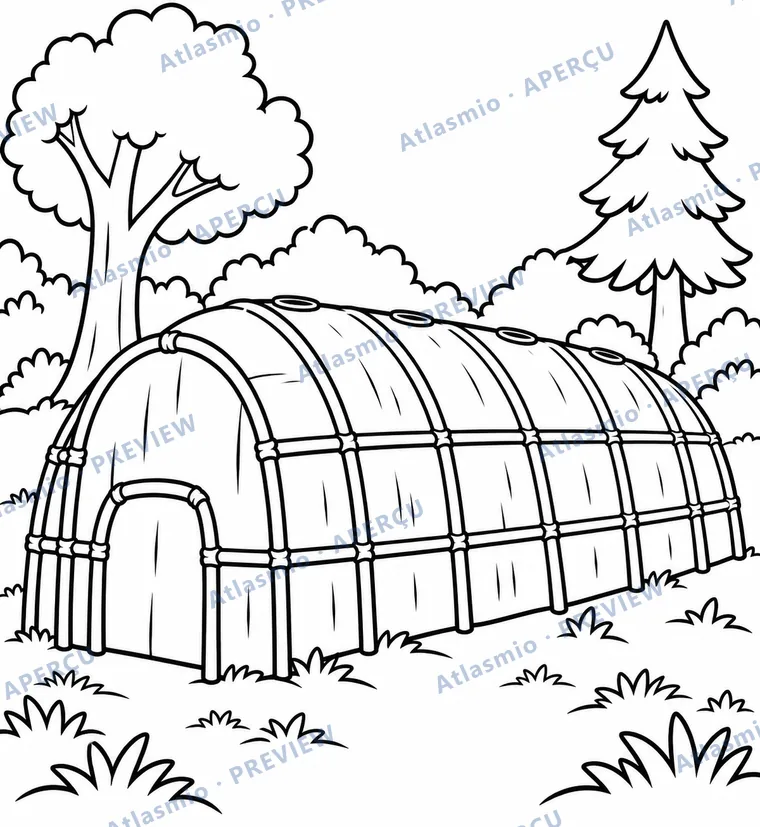
A longhouse is made of bark laid over wooden poles. Long ago, several Wendat families lived together under its big rounded roof. Today you can visit one at Wendake.
Look together
What do you think the holes in the roof are for?
An idea to try
Look at the roof’s outline together, then compare it with a house in your neighbourhood. Name similarities and differences without deciding that one shape is better.
For the adult reading along
A little more to discover
A longhouse sheltered several related families under one bark roof; the fires were lined up down the middle and the smoke left through openings in the roof. Before the French arrived, the Wendat lived this way in what is now southern Ontario. War, epidemics and famine disrupted their homeland in the mid-seventeenth century. In 1650, an initial group of about 300 Wendat refugees arrived at Québec; others followed. They moved several times, from Île d’Orléans to L’Ancienne-Lorette, before settling for good at Jeune-Lorette in 1697. The village, officially named Wendake in 1986, now lies near Québec City.
The Ekionkiestha’ national longhouse, built at Wendake in 2013, is a reconstruction: people build today to understand yesterday. Present Wendake as a living place. The Wendat themselves tell their history to visitors.
Sources and illustration notes (4)
A simplified interpretation of a longhouse reconstructed at Wendake today; this is not an architectural drawing.
These links lead to other websites. Explore them with an adult. References identify the institution and the related lesson; some linked pages are in French.
- Musée huron-wendat — Nos lieux (in French)Museum of the Wendat Nation in Wendake; contemporary longhouse inaugurated in 2013, the result of a reconstruction project. Culture and its transmission are present.
- Commission de toponymie — La toponymie des Hurons-Wendats (in French)Pages 12–13 of the PDF: dispersal, a first group of 300 refugees in 1650, further arrivals and moves until settlement at Jeune-Lorette in 1697.
- Wendake — Hôtel-Musée Premières Nations (in French)Ekionkiestha’ National Longhouse built in 2013.
- Commission de toponymie — Wendake (in French)Name made official on January 9, 1986; previously Village-des-Hurons (Indian reserve), from 1968 to 1986.
Page prepared on September 19, 2026. Illustrations simplify places and scenes; they are not historical documents.
This drawing is from the book Life in Old Québec to Colour
Tax calculated at checkout. Terms of sale