

Homes, Trades and Games of Long Ago · Drawing 16 of 40
The barrel maker at work
Since the days of New France
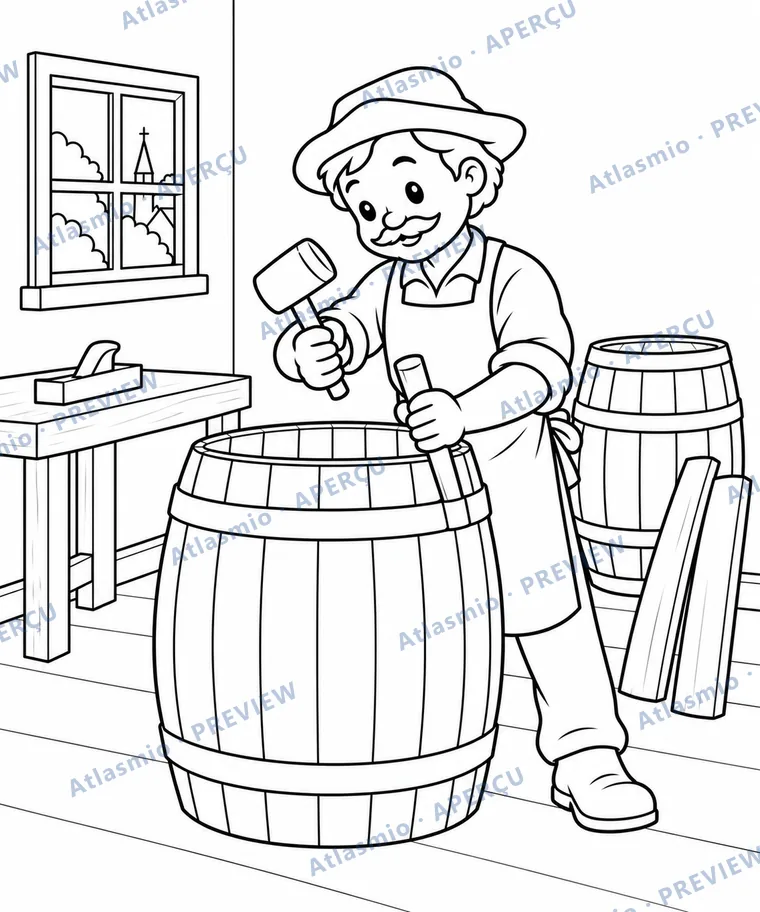
The barrel maker fits curved boards called staves together and tightens hoops around them to make a barrel. Long ago, barrels held flour, apples or water.
Look together
What holds the barrel’s boards together?
An idea to try
Roll a sheet of paper into a cylinder. An adult secures two paper bands around it. Your child observes how the cylinder and the bands work together.
For the adult reading along
A little more to discover
Barrels carried and stored many products, including grain, salted foods and liquids. Coopers fitted curved boards, called staves, together and tightened wooden or metal hoops around them. Historian Jean Provencher describes rue du Sault-au-Matelot in Québec City as a centre of cooperage in the eighteenth century. He dates the closure of its last workshop, run by J. R. Ed. Côté, to 1940, amid competition from mechanized workshops and changing packaging methods.
The colouring page shows how several parts make one container. The boards follow the height of the barrel, the hoops go around it. With your child, name those two directions and look for what holds the pieces together.
Sources and illustration notes (3)
An imaginary barrel maker and barrel; the construction is simplified to show the main pieces.
These links lead to other websites. Explore them with an adult. References identify the institution and the related lesson; some linked pages are in French.
- Office québécois de la langue française — Tonnelier (in French)Assembling staves and hoops of wood or metal to make and repair barrels.
- Jean Provencher, historien — Éloge du tonneau (in French)Uses of barrels, rue du Sault-au-Matelot and the closing of the Côté workshop in 1940; a signed overview that refers to Eileen Marcil’s study.
- Répertoire du patrimoine culturel du Québec — Michel-Marie Cureux dit Saint-Germain, maître tonnelier (in French)Master cooper in Québec City in the 18th century, with a workshop on rue du Sault-au-Matelot.
Page prepared on September 15, 2026. Illustrations simplify places and scenes; they are not historical documents.
This drawing is from the book Life in Old Québec to Colour
Tax calculated at checkout. Terms of sale