

Places, Traditions and Discoveries · Drawing 28 of 40
The fiddle makes us dance
Québec — traditional music
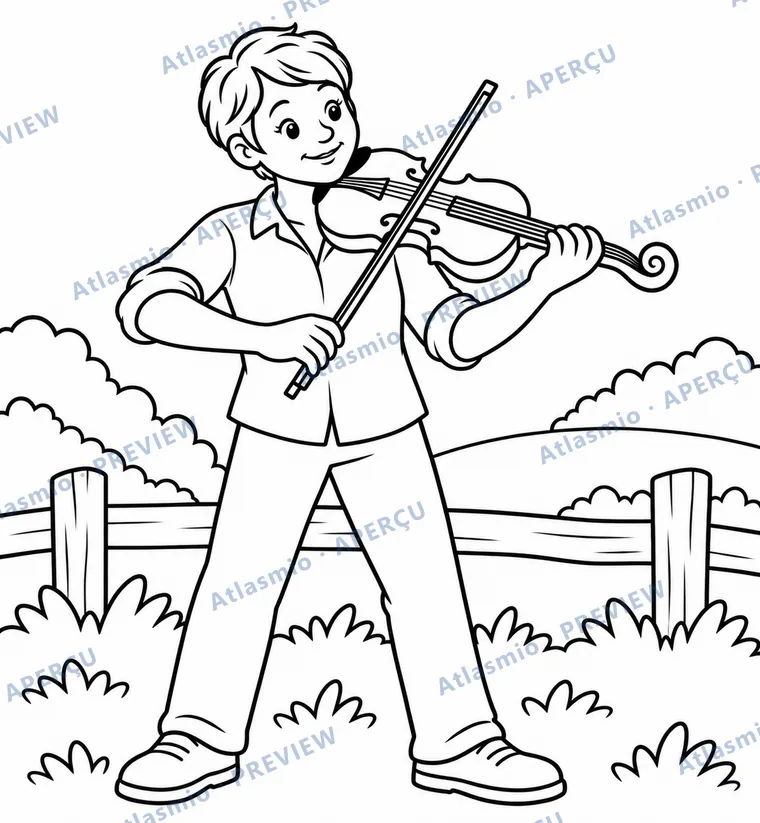
In Québec, the fiddle gets people dancing at many traditional music parties. Its bow rubs the strings to make sounds.
Look together
Can you imagine a lively or gentle tune?
An idea to try
Sitting comfortably, make a slow hand rhythm and then a faster one. Your child chooses one for their imaginary fiddle.
For the adult reading along
A little more to discover
The Canadian Encyclopedia presents fiddler and composer Isidore Soucy, born in Sainte-Blandine, near Rimouski, in 1899. After settling in Montréal in 1924, he began recording in 1926 and was heard on the radio for decades. Every fiddler has a personal style: the same instrument can sound different from one musician to another.
Observe the violin and bow, then imagine two kinds of music: calm and energetic. Your child can express them through a gesture or short rhythm. Knowing a traditional tune is not necessary to begin noticing movement, speed and expression.
Sources and illustration notes (1)
An imagined musician and instrument; no portrait of Isidore Soucy or particular piece of music is reproduced.
These links lead to other websites. Explore them with an adult. References identify the institution and the related lesson; some linked pages are in French.
- The Canadian Encyclopedia — Isidore SoucyFiddler and composer born in Sainte-Blandine, near Rimouski, in 1899; after settling in Montréal in 1924, he recorded from 1926 and was heard on the radio for many years.
Page prepared on September 27, 2026. Illustrations simplify places and scenes; they are not historical documents.

This drawing is from the book Québec Treasures to Colour
Tax calculated at checkout. Terms of sale