

Places, Traditions and Discoveries · Drawing 36 of 40
The arrow sash
Québec — textile skills
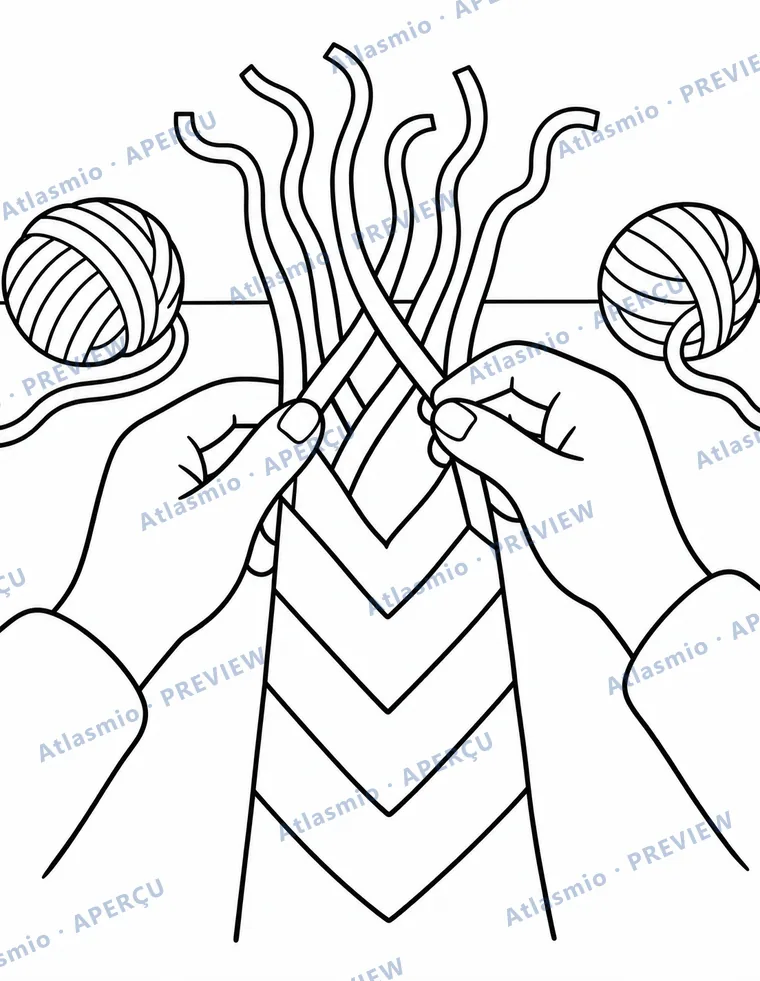
The arrow sash, or ceinture fléchée, is made with fingers, without a loom. Its coloured threads cross to form big points, like arrows.
Look together
Can you follow the direction of the big points?
An idea to try
Draw several large pointed shapes on a paper strip. Your child invents a repeating pattern of two or three colours.
For the adult reading along
A little more to discover
Fléché is a complex technique of interlacing threads with fingers. Québec’s cultural heritage directory explains how colours and crossings form points, sometimes called flames or lightning bolts. Practitioners make sashes as well as contemporary objects such as bookmarks and scarves. This heritage is shared: in the fur-trade era, Indigenous people also wore and made arrow sashes, and the sash is now one of the best-known symbols of the Métis Nation.
The skill is learned through activities including watching an experienced person and practising with them. For colouring, your child can simply follow the large points and choose a colour sequence. They explore a pattern without learning the technique itself. Ask which colour repeats and in what order.
Sources and illustration notes (2)
A simplified graphic pattern evoking fléché; it copies no sash attributed to a community or craftsperson and is not a weaving pattern.
These links lead to other websites. Explore them with an adult. References identify the institution and the related lesson; some linked pages are in French.
- Répertoire du patrimoine culturel du Québec — Fléché (in French)Finger-weaving technique, pointed patterns, transmission and the variety of objects made today; sashes were also worn and made by Indigenous people in the fur-trade era.
- Métis Nation of Ontario — Symbols and TraditionsThe sash (ceinture fléchée), one of the most visible symbols of the Métis Nation and a sign of pride and identity for Métis people.
Page prepared on September 12, 2026. Illustrations simplify places and scenes; they are not historical documents.
This drawing is from the book Québec Treasures to Colour
Tax calculated at checkout. Terms of sale