

Places, Traditions and Discoveries · Drawing 18 of 40
Montréal bagels
Montréal
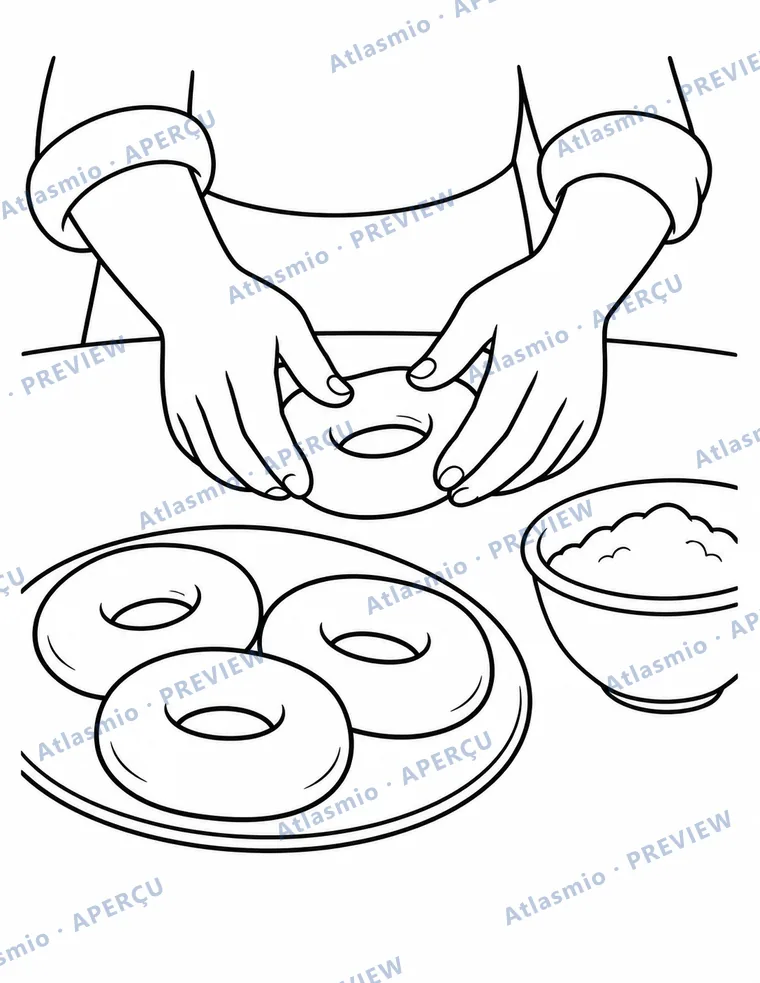
Bagels are part of Montréal’s food traditions. Jewish bakers from Eastern Europe brought them to the city. The dough is shaped into rings, dipped in boiling water, then baked in a wood-fired oven.
Look together
Can you draw a big ring in the air?
An idea to try
Roll modelling dough into a rope and join its ends to make a ring. Compare it with a flattened ball.
For the adult reading along
A little more to discover
Bagels are part of Montréal’s Jewish culinary heritage. The Museum of Jewish Montreal presents them among the foods that tell this history, passed on by generations of bakers and families. St-Viateur bakery, founded in 1957, describes bagels rolled by hand and baked in a wood-fired oven. This is one example of Montréal craftsmanship among the businesses and people who prepare this ring-shaped bread.
The drawing focuses on shaping: a length of dough becomes a closed form with a hole in the centre. Invite your child to follow the outline with a finger. Compare a ring with a solid disc and ask what would need to change to turn one into the other. No food preparation is needed.
Sources and illustration notes (3)
An imagined bakery and bagels, without signs or a reproduction of a particular shop’s interior.
These links lead to other websites. Explore them with an adult. References identify the institution and the related lesson; some linked pages are in French.
- St-Viateur Bagel — Notre histoire (in French)Founded in 1957; shaping by hand and baking in a wood-fired oven, as described by the bakery.
- Museum of Jewish Montreal — Beyond the BagelBagels among the specialties of Montréal’s Jewish culinary heritage; does not claim a single date of invention.
- The Canadian Encyclopedia — Montreal BagelsBagels arrived in Montréal with Jewish immigration from Eastern Europe in the early 1900s; the dough is boiled in honey-sweetened water, rolled by hand and baked in a wood-fired oven.
Page prepared on September 19, 2026. Illustrations simplify places and scenes; they are not historical documents.
This drawing is from the book Québec Treasures to Colour
Tax calculated at checkout. Terms of sale